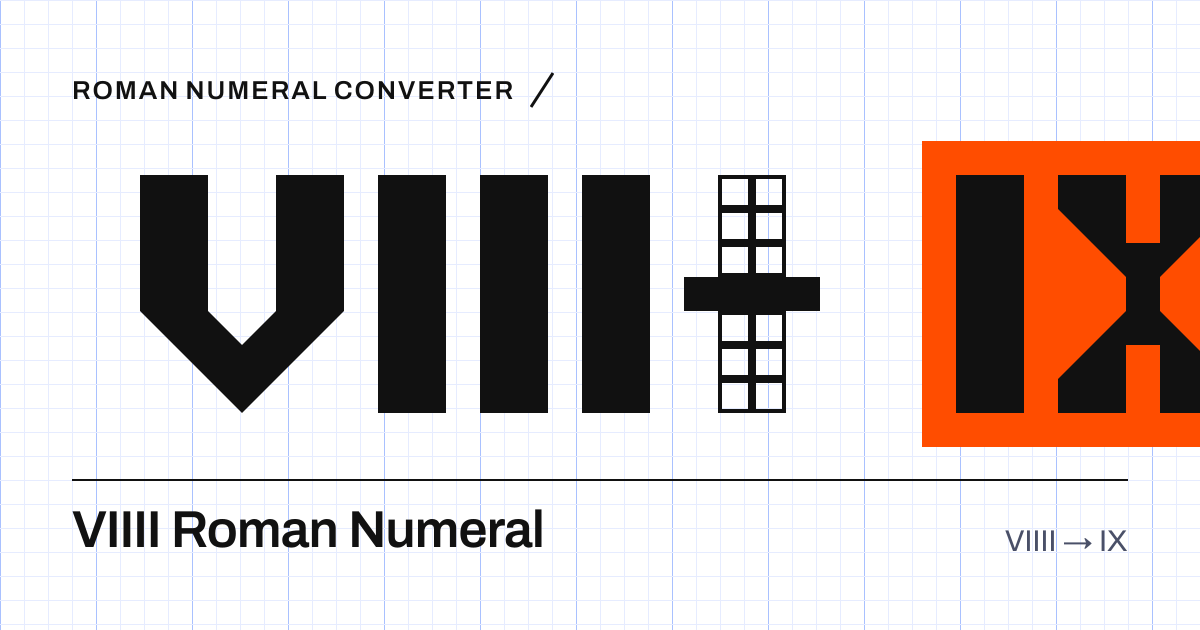
VIIII Roman Numeral
VIIII means 9, written the old additive way: V plus four I’s. The standard form is IX, ten minus one. The additive spelling still turns up in inscriptions and old documents, but in modern use it counts as a mistake.
The converter gives the same verdict: “Four Is after a five is an old additive form; the standard form uses subtraction.”
Numbers and numerals are detected as you type. Enter copies, Alt+S swaps.
- Four Is after a five is an old additive form; the standard form uses subtraction.
The additive form
The simplest way to write a number in Roman symbols is to add them up: take the largest symbol that fits, then keep adding smaller ones. That gives V + I + I + I + I for nine. It is easy to read and needs no rule about order, and it appears in older writing.
The form that became standard uses subtraction for the fours and nines: a single smaller symbol placed before a larger one is subtracted. Nine becomes I before X, IX, and the same pattern gives XC for 90 and CM for 900. A symbol never appears more than three times in a row, so VIIII, with four I’s, is ruled out.
VIIII is an old additive form; the standard form of 9 is IX. Wikipedia
IIII on clocks, IX for nine
Clock faces are the best-known place where the additive habit survives. Most clock faces with Roman numerals show four o'clock as IIII rather than IV, a tradition going back to the 14th-century Wells Cathedral clock. Wikipedia Clock faces that use IIII for four still write nine as IX, not VIIII. Wikipedia
So even on a dial that writes IIII, the nine is IX. If you are copying numerals from a clock, keep that in mind: the four is the exception, not a pattern.
The same slip in bigger numbers
Any number ending in 4 or 9 invites the same additive spelling. The converter flags each one:
- 14 is XIV, not XIIII. 14 in Roman numerals
- 19 is XIX, not XVIIII. 19 in Roman numerals
- 24 is XXIV, not XXIIII.
For the full list of forms that break the rules, such as IIV, XIIV, VX and IC, see invalid Roman numerals on the rules page. The standard form has its own page: IX roman numeral. And for the number itself, see 9 in Roman numerals.
Questions about VIIII
What number is VIIII?
Read additively, VIIII is 5 + 1 + 1 + 1 + 1 = 9. The standard way to write 9 is IX.
Is VIIII a correct Roman numeral?
Not in the modern standard. It is an old additive form: four I’s in a row, where the standard rules allow at most three and use subtraction instead.
Why do clocks show IIII but not VIIII?
Many clock faces keep the additive IIII for four, but the same dials write nine as IX, so VIIII does not appear on them.